



Our results
Your trust in us is a responsibility we take seriously. As professionals we always do our best to fulfill your dreams of parenthood.
Here in the Sanatorium Helios we choose specific methods and procedures that are proven, trusted and provably have a positive influence on the success of IVF cycles.
Our employees are qualified and experienced professionals who take this work as their vocation. They are equipped with the most advanced technology that is available at our clinic thanks to continuous investments and collaboration with the global leader in IVF technology, the Australian group Genea.
Our success rate puts us among the best IVF centers worldwide even though we often work with couples with complicated anamnesis that have been unsuccessful in other clinics.
We do not consider a positive pregnancy test our measure of success. It is the birth of a healthy baby which you take home from the hospital.
Our long-term statistics, which we regularly track, show that every other patient that comes to us in the year carries a healthy baby to term and gives birth (52% births of healthy fetuses per patient).
Probability of a birth after FET in Sanatorium Helios vs. the national average:
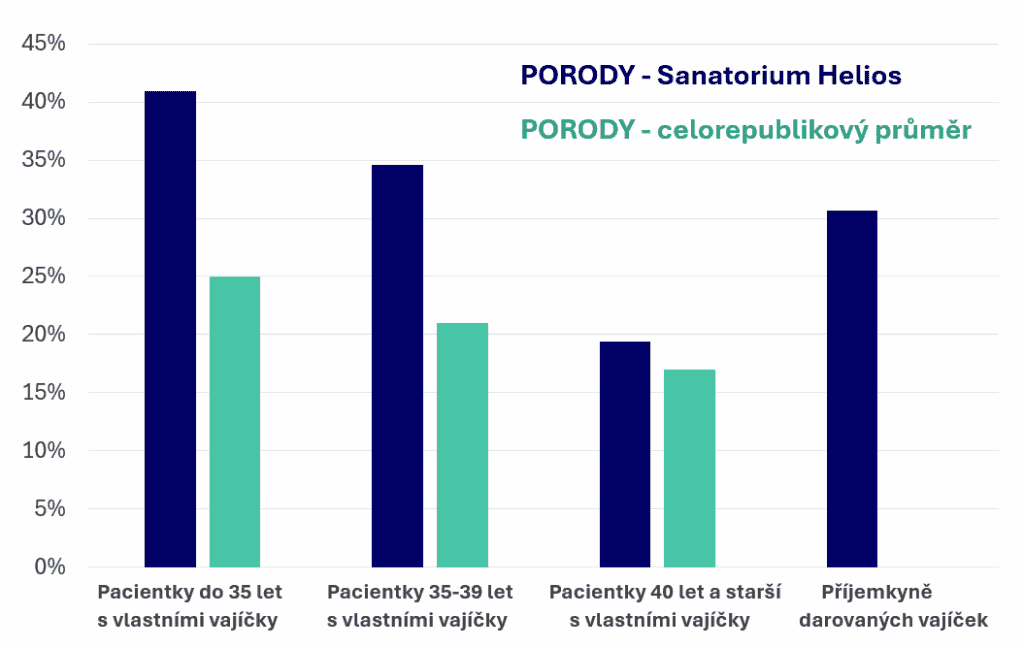
The success of cryo-embryo transfer (FET) can be evaluated by a successful implantation of the embryo (a positive hCG level in the patients’ blood), confirmed clinical gravidity (heart action of the fetus confirmed by an ultrasound) and lastly – for us (and for you) the most important parameter – successful live birth. In this graph, we split patients with their own eggs into a group based on their age during the egg retrieval and a group of recipients of the donated eggs.
V grafe sme rozdelili skupinu pacientok s vlastnými vajíčkami podľa ich veku v čase odberu vajíčok a úplne osobitne sú zobrazené príjemkyne darovaných vajíčok.
Dark blue (3,907 FETs in Sanatorium Helios; 2020–8/2024):
Generally we can say that with patients 39 years old or younger there is nearly 40% chance of birth after one transfer at Sanatorium Helios. With older patients the egg quality is very variable, the success rate goes down every year, in case of using donated eggs the success rate for older women is getting similar to the success rate of younger patients.
Turquoise (the national average):
For comparison we state the data from the national registry, where all centers in the Czech Republic are required to report their cycles (National registry of assisted reproduction, NRAR; https://www.uzis.cz/res/f/008420/asistreprodukce2020.pdf) Across all patient categories (even though the data from the registry contains cycles with own eggs as well as with the donor eggs) Sanatorium Helios is well above the national average.
The success rate of one cycle with egg retrieval (regardless of the number of performed transfers form the cycle):
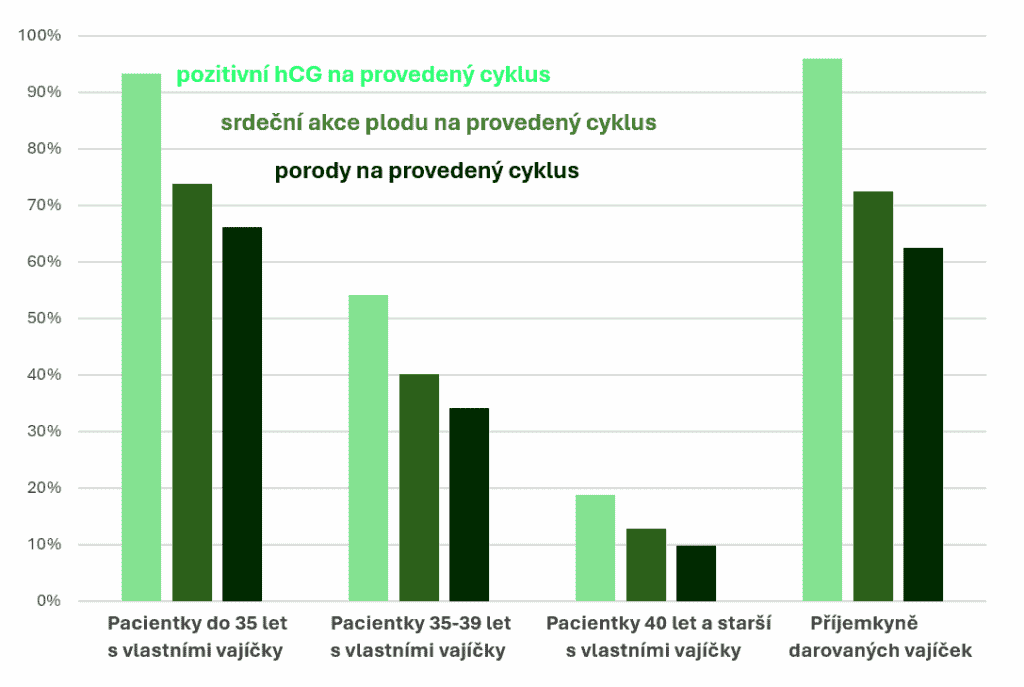
The graph shows the success rate of IVF cycles with the puncture of at least one ripe egg done in Sanatorium Helios during the year 2018 to 2023. Patients are divided based on their age during the egg sampling( the acceptors of donated eggs are stated separately).
The success of each and one of the FETs can be evaluated by a successful attachment of the embryo (positive hormone hCG in the patients’ blood), confirmed clinical gravidity( heart action of the fetus confirmed by an ultrasound) and lastly by successful delivery. The success rates are measured cumulatively – that means the number of performed transfers is irrelevant – the goal is always a successful delivery,regardless of the number of attempts.
The success of patients over 40 years old is strongly affected by a small amount and bad quality of eggs. In case the older patient is the acceptor of donor eggs, the success rate of the cycle is identical to patients 35 years or younger.
With patients under 39 years old, we can generally say that they achieve a successful live birth after an average of 2.5 embryo transfers (see the graph showing success rates for individual frozen embryo transfers, FETs). From each cycle with retrieval of the patient’s own eggs in this age group, we obtain an average of three embryos. In cycles from 2018–2023, an average of 1.4 transfers per cycle have been performed to date, meaning that more than half of the embryos are still cryopreserved and awaiting use. Consequently, the cumulative success rate of these cycles is expected to continue increasing in the coming years.